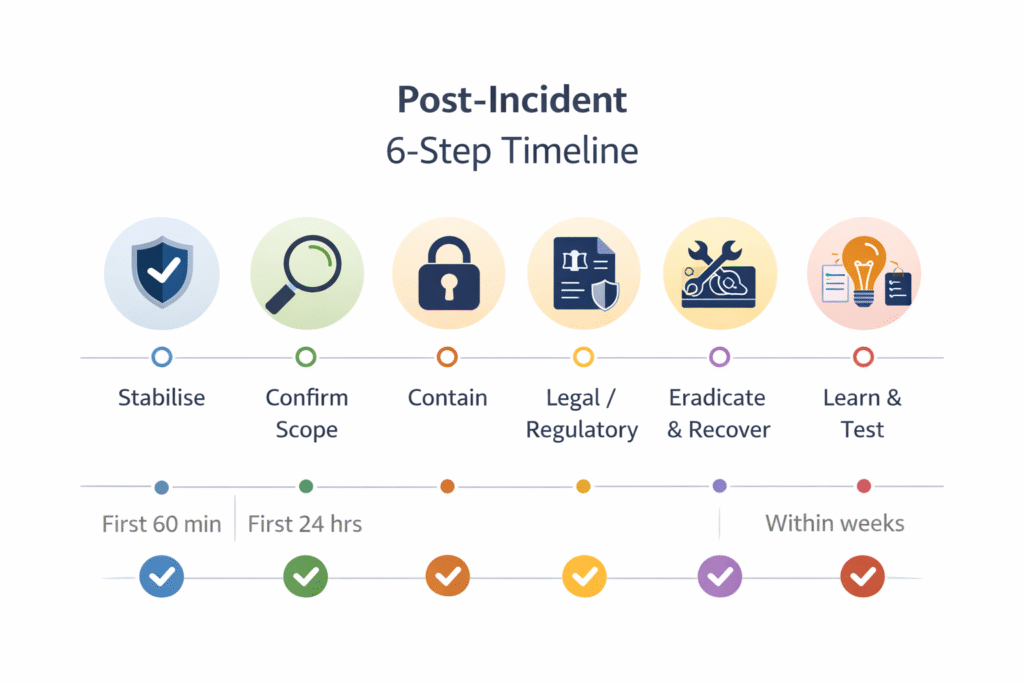
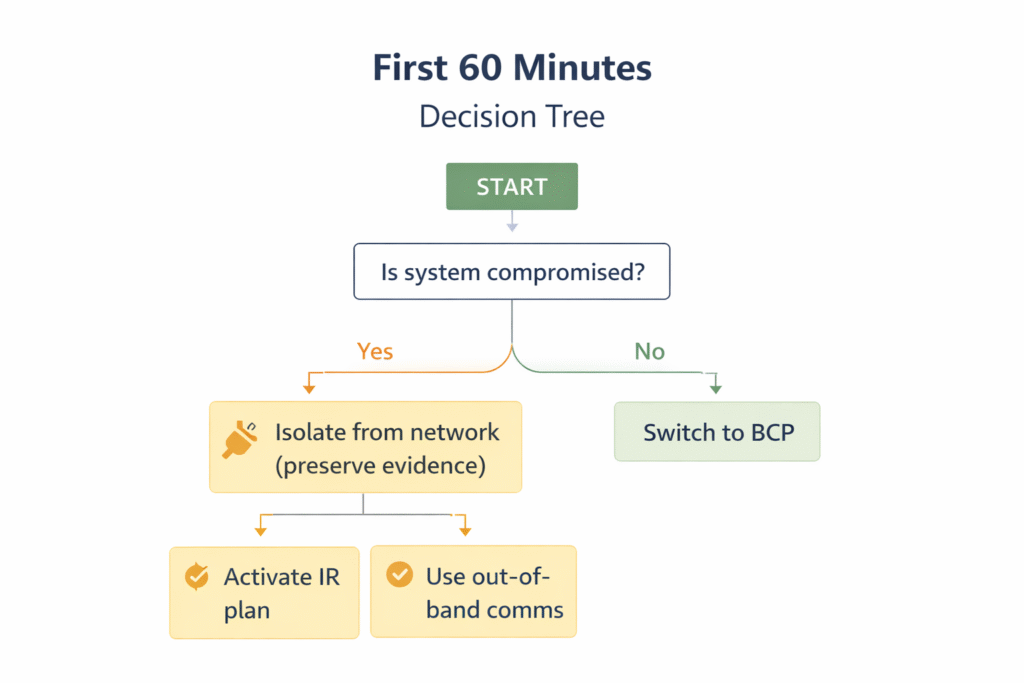
First 60 minutes: Isolate affected systems, activate your incident response plan, and switch to out-of-band communications.
Confirm scope and preserve evidence before making disruptive changes.
Contain surgically — segment and monitor rather than mass shutdowns or resets.
Engage legal and regulators early (PDPO, HKMA / SFC / IA).
Recover in controlled phases with validation, not assumptions.
Turn the incident into improvement through red and purple team testing.
Who this is for:
Board members, C-suite executives, CISOs, IT leaders, and risk/compliance teams in Hong Kong enterprises who need clear, practical guidance — not theory — when an incident occurs.
Executives rarely plan to become “post-breach leaders,” but in 2026 this has become reality for many Hong Kong organisations across finance, insurance, retail, and critical services. Whether the incident is ransomware, business email compromise, or large-scale data theft, the first hours and days determine whether the event becomes a contained disruption or a prolonged crisis.
This guide is a practical, non-vendor playbook based on real incidents handled in Hong Kong enterprises. It focuses on what works when time, evidence, reputation, and regulatory obligations are all on the line.
Step 1 — The First 60 Minutes: Stabilise Without Panicking
Executive takeaway: Early overreaction causes more damage than the attacker.
The first hour sets the tone for everything that follows. Rushed “fixes” can destroy evidence, breach contracts, and significantly increase recovery costs.
Focus on safety and containment — not instant eradication
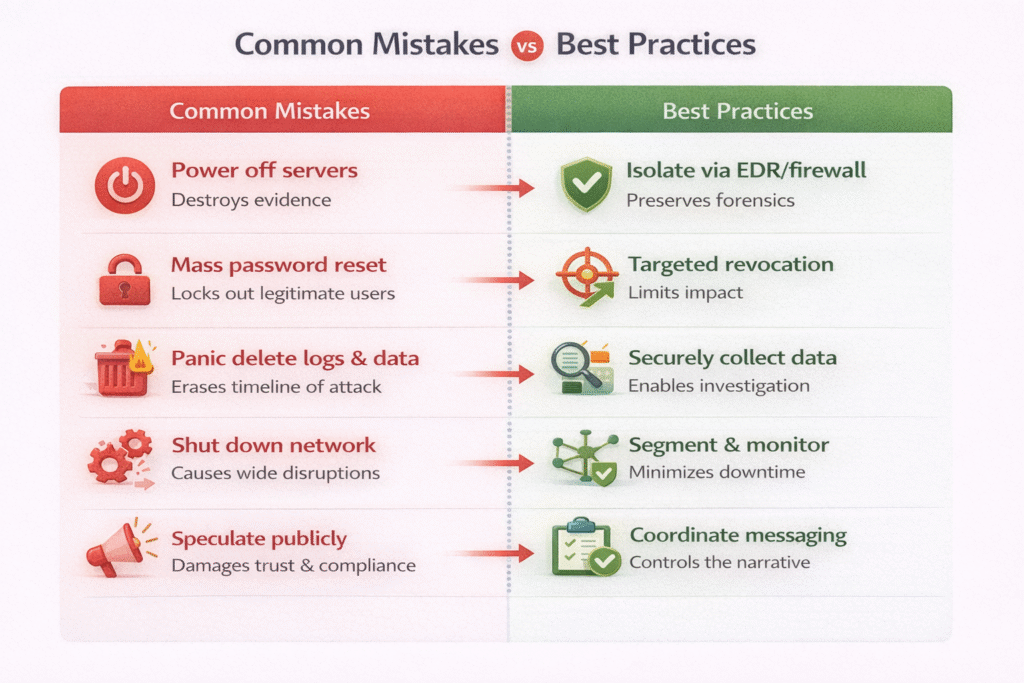
Isolate clearly compromised endpoints or servers using firewall rules or EDR quarantine rather than powering them off.
This preserves volatile memory and logs critical for forensic reconstruction.
If critical services are impacted, switch to documented business continuity procedures instead of improvising.
Activate your incident response team
Convene a small, empowered group: IT/security lead, legal/compliance, key system owners, and a senior business decision-maker.
Establish a single out-of-band communication channel in case corporate email or collaboration tools are compromised.
Golden Rule of the First Hour
Preserve evidence first. Every action you take can erase attacker footprints that would otherwise reveal entry points, scope, and dwell time.
Step 2 — Confirm the Incident and Understand Scope
Executive takeaway: Assumptions destroy good incident response.
Validate and classify the incident
Correlate EDR alerts, SIEM data, user reports, and third-party notifications.
Confirm this is a genuine cyber incident — not a misconfiguration or false positive.
Classify the type: ransomware, BEC, data theft, web compromise, or insider misuse.
Start an evidence trail immediately
Create a simple timeline of discovery, decisions, and actions taken.
Preserve logs, memory, and configurations before large-scale resets or reimaging.
Step 3 — Contain the Attack Without Breaking Everything
Executive takeaway: Containment is about control, not chaos.
Apply targeted containment
Quarantine specific endpoints or revoke compromised identities and tokens.
For application attacks, deploy emergency WAF rules or access controls around affected functions.
Segment and monitor — don’t blindly shut down
Tighten segmentation between affected and crown-jewel systems.
Increase monitoring even on systems that appear unaffected.
Containment Principle
Do the minimum necessary to stop attacker movement. Unnecessary shutdowns destroy evidence and extend downtime.
Step 4 — Legal, Regulatory and Communications Actions
Executive takeaway: Poor communication creates regulatory risk even when technical response is sound.
Assess notification obligations early
Under Hong Kong’s PDPO, notification is expected where there is real risk of harm.
HKMA, SFC, and IA expect prompt reporting of material incidents — often immediately once understood.
Coordinate external communications
Align messaging across customers, partners, regulators, and media.
Avoid speculation; communicate what is known, what is being investigated, and when updates will follow.
Step 5 — Eradicate, Recover and Validate
Executive takeaway: Recovery without validation invites reinfection.
Remove the threat and close entry paths
Rebuild compromised systems from trusted images.
Rotate credentials, keys, and tokens.
Fix root weaknesses such as exposed services, weak MFA, or flat network design.
Recover in controlled phases
Bring systems back online incrementally.
Validate with monitoring and targeted testing, not assumptions.
Step 6 — Learn, Improve and Test
Executive takeaway: The real failure is learning nothing.
Run a structured post-incident review
Assess detection, escalation, decision-making, communications, and regulatory handling.
Assign owners, timelines, and funding for remediation actions.
Validate improvements realistically
Use red or purple team simulations to test whether the same attack path still works.
Run tabletop exercises with executives to rehearse future decision-making.
Resilience Insight
An incident only improves security if it changes behaviour, architecture, and decision-making — not just controls on paper.
How External Experts Can Help
Even mature teams benefit from experienced external support during and after serious cyber incidents.
During an active incident, incident response and forensic specialists can rapidly scope attacker activity, preserve evidence, and structure regulator-ready communications aligned with Hong Kong expectations.
After containment, red and purple team exercises validate that attack paths are truly closed and help translate lessons learned into concrete improvements across technology, process, and governance.
If your organisation is dealing with an active incident — or wants to be better prepared before the next one — contact DarkCode for a no-obligation conversation. We help Hong Kong enterprises contain, recover, and emerge stronger after real attacks.